
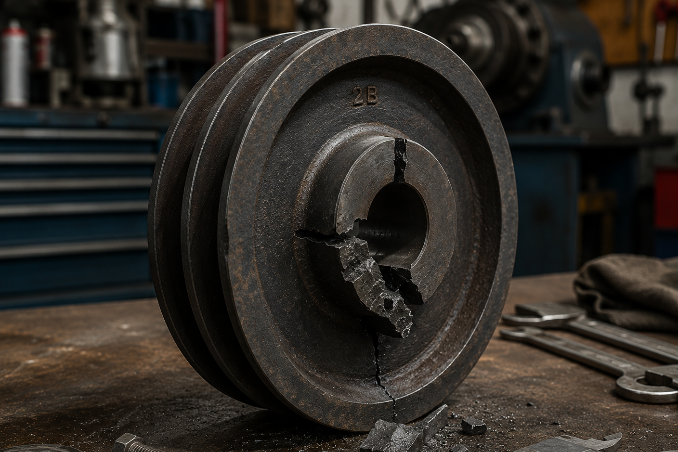
There's a familiar moment in a lot of Kiwi workshops and sheds: a pulley's let go, the belt's flapping around uselessly, and the machine's dead until it's sorted. You go to order a replacement and realise you're holding a worn, greasy, unmarked lump of cast iron with no idea what to actually search for.
Good news — identifying a pulley isn't complicated once you know what to measure and in what order. This guide walks through it step by step, whether you're replacing exactly what was there or speccing a pulley for something you're building from scratch.
Step 1: Measure the Outside Diameter (OD)
Grab a tape measure or calipers and measure straight across the outside edge of the pulley, through the centre. This is the OD, and it's usually the single biggest factor in how the pulley is named — a "150mm pulley" has roughly a 150mm outside diameter.
A word of caution: OD is a useful starting point, but it's not the number that actually determines how fast the belt runs or how much power the drive can handle — that comes down to the pitch diameter, which we'll get to in Step 3.
Step 2: Count the Grooves
How many V-belts does the pulley carry? One groove is a single pulley; two or more side by side is a multi-groove or "banded" arrangement, sometimes built by bolting two single-groove pulleys together (this is exactly how our Bi-Loc range creates a double-groove pulley — two singles joined with a long bolt set, no separate double-groove casting required).
Multi-groove pulleys must match exactly — same number of grooves, same section, same pitch diameter — or the belts won't share load evenly and you'll get premature wear on whichever one is fractionally tighter.
Step 3: Identify the Belt Section
This is the step most people skip, and it's the one that causes the most mismatched orders. The "section" refers to the shape and size of the V-groove — classical (A, B, C, D), wedge (SPZ, SPA, SPB, SPC), or cogged/raw-edge variants of either. A pulley cut for an A-section belt won't properly seat a B-section belt, even though they can look deceptively similar side by side.
If you've still got the old belt, the section is usually printed right on it. If you don't, we've written a full guide on this: How to Identify and Measure a V-Belt the Right Way — worth reading alongside this one, since belt and pulley identification go hand in hand.
Once you know the section, the pitch diameter (the effective diameter the belt actually runs on, measured slightly inside the groove rather than at the outer edge) is what determines drive speed and ratio — this is the number to match precisely when replacing a pulley on an existing drive.
Step 4: Measure the Bore, and Check for a Keyway
The bore is the diameter of the hole through the centre, where the shaft goes. Measure straight across, through the centre, same as the OD.
While you're in there, check whether there's a keyway — a rectangular slot cut into the bore designed to line up with a matching key on the shaft, stopping the pulley from spinning independently of the shaft. Some systems (including our Bi-Loc range) do away with the keyway entirely, gripping the shaft through a tapered bush instead — more on that below.
Step 5: Pilot Bore, Taperlock, or Biloc?
This is where a lot of the "which one do I actually need" confusion comes from, so it's worth understanding the three broad types you'll come across:
|
Type |
How it grips the shaft |
Reusable on other shaft sizes? |
|
Bored to one exact size, secured with a key and grub screw |
No — bore size is machined to suit specific shaft |
|
|
A separate tapered bush pulled into the pulley's tapered centre by bolts, gripping the shaft as it's drawn in |
Yes — same pulley can take different taperlock bush sizes |
|
|
Similar concept to taperlock, using a keyless tapered bush system, but designed for faster fitting and removal with basic hand tools, and without needing a key or grub screw at all |
Yes — same pulley works across a wide bush size range, and two pulleys can be joined into a double-groove arrangement |
If your old pulley used a key and grub screw and you're upgrading to a bushed system like taperlock or Biloc, no shaft machining is needed — the bush does the work the keyway used to do.
Step 6: Check for Any Markings
Before you measure everything from scratch, have a look for a part number or size stamped into the pulley face or hub — manufacturers often mark the section, number of grooves, and pitch diameter directly on the casting. Worn or painted-over pulleys can hide these, so a quick clean with a rag (or a wire brush if it's really caked on) before you start measuring can save you the whole exercise.
Considering a Biloc Pulley for Your Replacement?
If you're replacing a worn pulley, it's worth considering whether you need to replace it with the exact same shaft mounting system.
Traditional pilot bore pulleys are machined to a specific shaft size and typically require a keyway and grub screw. Taperlock pulleys improve flexibility through interchangeable bushes, while Biloc pulleys take this a step further with a keyless design that is quick to install and remove using basic hand tools.
Biloc pulleys offer several advantages:
- One pulley can be used with multiple shaft sizes by selecting a different bush.
- No keys or grub screws required.
- Easy fitting and removal.
- No shaft machining required.
- Suitable for A, AX, SPA, B, BX and SPB belts.
- Two pulleys can be joined together to create a double-groove assembly.
If you're replacing an older keyed pulley and don't need to retain the original mounting arrangement, a Biloc pulley can often provide a more flexible and easier-to-maintain solution.
View our Biloc Pulley Range
View Compatible Biloc Bushes
Quick Checklist Before You Order
- Outside diameter (OD)
- Number of grooves
- Belt section (A, B, C, D, SPZ, SPA, SPB, SPC, etc.)
- Bore size, and whether a keyway is present
- Bush type if applicable — fixed, taperlock, or Biloc
- Any part numbers or markings still visible
Getting these six details sorted before you call or order means you get the right pulley the first time — no second freight charge, no second wait, and no machine sitting idle any longer than it needs to.
If you've measured up and you're still not sure what you're holding, our team's happy to help you match it — we carry pilot bore, taperlock and Biloc pulleys across metric and imperial sizes, NZ wide.
Cheers,
Mike