
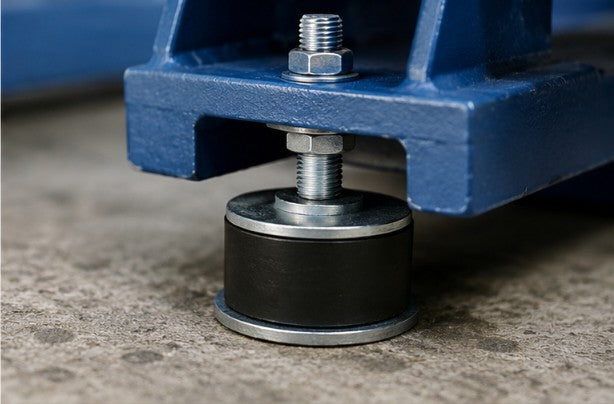
If you've ever walked through a workshop, factory, processing plant or farm and heard a machine rattling, humming or shaking more than it should, you're not alone.
Across New Zealand, excessive machinery vibration is one of the most common—and most overlooked—causes of premature equipment failure. Left unchecked, vibration can damage bearings, loosen fasteners, crack welds, increase noise, shorten machine life and lead to costly unplanned downtime.
A compressor is shaking across the floor. A pump is rattling through the pipework. A generator is making the whole shed hum. A fan sounds like it is trying to leave the building. Or a vibrating screen is hammering away harder than it should, and everything around it is slowly working loose.
At that point, the question is usually pretty simple:
How do I stop this thing shaking itself, the floor, or everything around it to bits?
That is where anti-vibration mounts and rubber spring isolators come in.
They are not magic, and they will not fix every mechanical problem. If your machine has a collapsed bearing, a badly misaligned coupling, an out-of-balance fan, or a bent shaft, those problems need to be fixed first. But when the vibration is part of normal machine operation, the right mount can make a big difference to noise, fatigue, machine life and operator comfort.
This guide walks through what anti-vibration mounts do, how they work, how to choose them, and where rubber spring isolators fit in.
If you already know you need standard rubber machine mounts, you can browse our range here.
If you are dealing with heavier dynamic applications like vibrating screens, feeders, conveyors or processing equipment, have a look here.
RR Fisher stocks a wide range of anti-vibration mounts and AEON rubber springs for industrial vibration isolation applications in New Zealand.
What Is Vibration?
Vibration is repeated movement around a central position.
In machinery, that movement might be:
- Up and down
- Side to side
- Backwards and forwards
- Rotational
- A combination of all of the above
A small amount of vibration is normal in most machines. Anything with a rotating shaft, belt drive, fan, motor, pump, compressor, engine or gearbox will create some level of vibration.
The issue is not always that the machine vibrates. The issue is whether that vibration is being controlled.
If vibration is allowed to travel into the floor, frame, structure, pipework or surrounding equipment, it can create noise, wear, cracking, loosening and premature failures.
Why Does Machinery Vibrate?
Machinery vibrates because forces are being generated while it runs.
Common causes include:
- Rotating shafts
- Electric motors
- Belt drives
- Pulleys
- Couplings
- Gears
- Bearings
- Fans
- Pumps
- Compressors
- Engines
- Reciprocating motion
- Product impact on conveyors
- Vibrating screens and feeders
Some vibration is part of the machine’s normal operation. A compressor creates pulsation. A diesel engine creates firing pulses. A vibrating screen is literally designed to vibrate.
Other vibration is a warning sign.
For example:
- A fan may vibrate because the impeller is out of balance.
- A pump may vibrate because it is cavitating.
- A motor may vibrate because the bearings are failing.
- A drive may vibrate because the pulleys are misaligned.
- A machine may shake because the frame is loose or cracked.
This distinction matters.
Anti-vibration mounts are there to isolate normal vibration. They are not a substitute for fixing a mechanical fault.
Why Vibration Is a Problem
Uncontrolled vibration costs money because it causes fatigue.
A machine does not need to fail in one dramatic moment. Often, vibration damages equipment slowly. A bolt loosens. A weld starts to crack. A bearing runs hotter than it should. A pipe fitting starts weeping. A control box rattles until a terminal works loose.
Then one day the machine stops.
Common vibration-related problems include:
|
Problem |
What Happens |
Result |
|
Bearing failure |
Bearings are repeatedly loaded by vibration or misalignment |
Heat, noise and premature failure |
|
Loose fasteners |
Vibration reduces clamp load over time |
Guards, brackets and bases come loose |
|
Cracked welds |
Repeated flexing causes fatigue |
Frames and supports crack |
|
Shaft fatigue |
Cyclic loading stresses the shaft |
Shaft failure or runout |
|
Seal failure |
Shafts and housings move more than they should |
Leaks and contamination |
|
Electrical faults |
Vibration shakes terminals, sensors and boards |
Intermittent faults |
|
Pipework damage |
Rigid pipework carries machine vibration |
Cracked fittings or leaks |
|
Noise |
Vibration travels into panels, floors or ducting |
Operator complaints |
|
Structural damage |
Vibration enters floors, platforms or frames |
Cracking or loosening |
A good anti-vibration setup reduces how much vibration gets passed into the machine base, floor, building or attached equipment.
How Anti-Vibration Mounts Work
An anti-vibration mount places a flexible material, usually rubber, between the machine and the structure supporting it.
The rubber acts like a spring.
When the machine vibrates, the rubber allows a controlled amount of movement. Instead of the vibration being passed directly into the floor or frame, part of that movement is absorbed and isolated by the mount.
Think of it like the difference between:
- Bolting a compressor hard down to concrete
- Sitting that same compressor on correctly selected rubber mounts
With no mounts, the vibration path is direct. Machine into base. Base into floor. Floor into building.
With mounts, the rubber interrupts that path.
That is the basic idea behind vibration isolation.
Isolation vs Damping: What Is the Difference?
These two words often get mixed up.
Vibration Isolation
Isolation means reducing the amount of vibration transferred from one thing to another.
Example:
A pump vibrates, but the anti-vibration mounts reduce how much vibration reaches the concrete floor.
Vibration Damping
Damping means reducing vibration energy within a system.
Rubber does provide some damping because it flexes and loses a small amount of energy as heat. This is called hysteresis.
The Simple Version
Most rubber anti-vibration mounts are mainly used for isolation.
They reduce vibration transfer.
They do not always remove the source of vibration.
So if the source is a bad bearing, bent shaft, misalignment, cavitation or imbalance, the real issue still needs to be fixed.
What Is Static Deflection?
Static deflection is one of the most important ideas in vibration isolation, but it is also one of the easiest to explain.
Static deflection is how much the mount compresses under the weight of the machine.
For example:
- Unloaded mount height: 50 mm
- Loaded mount height: 45 mm
- Static deflection: 5 mm
In general, a softer mount will deflect more. More deflection usually means better isolation, but also more machine movement.
That last part matters.
If the mount is too stiff, it may not isolate much vibration.
If the mount is too soft, the machine may rock, walk, move too far on start-up, or put stress into pipework, belts, guards or couplings.
So the aim is not just to choose the softest mount. The aim is to choose the right mount for the machine weight, speed, movement and environment.
What Is Resonance?
Resonance is what happens when the vibration frequency from the machine is close to the natural frequency of the mounted system.
In plain English:
The machine and the mount start working together in the worst possible way.
Instead of reducing vibration, the movement gets bigger.
That is why a machine can sometimes seem worse after being put onto the wrong mounts.
It does not mean anti-vibration mounts do not work. It usually means the mount stiffness, machine speed, load or installation arrangement is wrong.
A classic example is a fan or motor mounted on rubber that shakes heavily at a certain speed, then smooths out above or below that speed. That can be a resonance issue.
Common Types of Anti-Vibration Mounts
There are many styles of vibration mounts, but most common industrial applications use a handful of basic types.
Cylindrical and Bobbin Mounts
These are the classic round rubber mounts with threaded studs, tapped holes, or a combination of both.
They are commonly used on:
- Small electric motors
- Pumps
- Compressors
- Control panels
- Small generators
- Guards and brackets
- Light equipment
They are simple, compact and easy to fit.
The trap is choosing one by size alone. Two mounts might look almost identical but have different rubber hardness, load ratings or thread arrangements.
RR Fisher’s anti-vibration mount range includes many common A, B, C and D style mounts in different sizes and thread configurations.
Sandwich Mounts
Sandwich mounts use rubber bonded between metal plates.
They are often used where the load needs to be spread across a wider area.
Common applications include:
- Engine bases
- Pump sets
- Generator sets
- Machine frames
- Industrial skids
They can be very effective, but they need to be loaded correctly. If the mount is installed in the wrong direction or overloaded, performance and service life will suffer.
Bell Mounts
Bell mounts are shaped to provide controlled movement and load support.
They are often used under:
- Generators
- Compressors
- Engines
- Industrial machinery
They can provide good isolation where the mount is matched properly to the machine weight and operating conditions.
Conical Mounts
Conical mounts are shaped like a cone and are often used where there is a need to control movement in more than one direction.
Common applications include:
- Engines
- Mobile equipment
- Cabs
- Heavier machinery
- Shock-loaded equipment
They can be useful where the mount has to handle vertical load as well as sideways movement.
Levelling Mounts
Levelling mounts combine machine support with height adjustment.
They are common under:
- Machine tools
- CNC machines
- Packaging machinery
- Workshop equipment
- Production machinery
They are helpful where the machine needs to be levelled accurately, but not all levelling feet are designed for serious vibration isolation. For heavy vibration, check the mount type and load rating carefully.
Fail-Safe Mounts
Fail-safe mounts are designed so that if the rubber element fails, the mounted equipment is still retained.
They are commonly used in:
- Mobile plant
- Engines
- Vehicles
- Marine equipment
- Critical equipment
If the machine can move dangerously if the rubber fails, a fail-safe style mount should be considered.
Wire Rope Isolators
Wire rope isolators use loops of stainless wire rope between metal bars.
They are not as common for everyday workshop machinery, but they are useful in harsh shock and vibration environments.
Applications include:
- Defence
- Marine
- Transport
- Electronics
- Equipment exposed to shock loads or temperature extremes
They are usually more specialised and more expensive than standard rubber mounts.
Rubber Spring Isolators
Rubber spring isolators are different from small standard rubber mounts.
They are designed for heavier dynamic loads and large repeated movement.
You will often see rubber springs used on:
- Vibrating screens
- Feeders
- Conveyors
- Quarry equipment
- Processing machinery
- Bulk handling equipment
- Mining equipment
- Agricultural and industrial machinery
A normal bobbin mount might be perfect for a small motor or compressor. But for a vibrating screen or feeder, you usually need something built for repeated dynamic movement.
That is where rubber springs come in.
RR Fisher stocks AEON rubber springs for heavy-duty shock absorption and vibration isolation in industrial equipment. You can view the range here:
Anti-Vibration Mounts vs Rubber Springs
|
Feature |
Anti-Vibration Mounts |
Rubber Spring Isolators |
|
Best for |
General machinery vibration |
Heavy dynamic and shock loads |
|
Common use |
Motors, pumps, compressors, generators |
Screens, feeders, conveyors, processing equipment |
|
Movement |
Usually smaller movement |
Larger controlled movement |
|
Load type |
Static and moderate dynamic loads |
Repeated dynamic loads |
|
Typical environment |
Workshops, factories, plant rooms |
Quarries, mines, processing plants, conveyors |
|
Selection focus |
Weight, RPM, mounting style, environment |
Dynamic load, travel, frequency, equipment motion |
If the machine is a small pump, motor or compressor, start by looking at standard anti-vibration mounts.
If the machine is designed to shake, feed, sort, screen or absorb heavy impact, rubber springs may be the better starting point.
Rubber Compounds: Why Material Matters
Not all rubber is the same.
The rubber compound affects vibration performance, oil resistance, weather resistance, temperature capability and service life.
|
Rubber Type |
Strengths |
Limitations |
Common Uses |
|
Natural Rubber |
Excellent resilience and vibration isolation |
Poor oil and UV resistance |
General vibration mounts and dynamic applications |
|
Neoprene |
Better weather and oil resistance than natural rubber |
Moderate dynamic performance |
Outdoor equipment, HVAC, general machinery |
|
Nitrile |
Good oil and fuel resistance |
Poorer UV and ozone resistance |
Oily machinery areas, fuel exposure |
|
EPDM |
Good UV, ozone and weather resistance |
Poor oil resistance |
Outdoor equipment, water treatment, HVAC |
|
Silicone |
Handles high and low temperatures |
Higher cost and lower tear strength |
Special temperature applications |
The key point is simple:
A mount that works well in a clean indoor workshop may not last long in oil, diesel, sunlight, washdown, fertiliser, chemicals or quarry dust.
If the environment is harsh, material selection matters.
How to Choose the Right Anti-Vibration Mount
Choosing a vibration mount is not just about finding something with the same thread or outside diameter.
Start with these questions.
1. What Is the Machine Weight?
Find the full operating weight, including:
- Motor
- Base frame
- Oil
- Water
- Product load
- Guards
- Accessories
- Any attached components
Do not just use the motor weight if the mount is supporting the full machine.
2. How Many Mounting Points Are There?
Most machines use four mounts, but not always.
Some use:
- Three mounts
- Four mounts
- Six mounts
- Eight or more mounts
Count the actual load points.
3. What Is the Load Per Mount?
For a simple evenly loaded machine:
Load per mount = total machine weight ÷ number of mounts
Example:
A 240 kg machine on four mounts:
240 kg ÷ 4 = 60 kg per mount
So each mount needs to support around 60 kg.
But be careful. That only works if the load is evenly distributed.
4. Is the Weight Evenly Distributed?
Many machines are heavier at one end.
Examples:
- Motor on one side
- Gearbox on one end
- Pump head offset
- Engine flywheel end heavier
- Product load not central
- Tank partly full
If the centre of gravity is not central, one pair of mounts may carry much more load than the other.
In those cases, you may need different mount ratings at different positions.
5. What Speed Does the Machine Run At?
Operating speed matters.
Record:
- RPM
- Fixed or variable speed
- Start-up behaviour
- Shutdown behaviour
- Any speed where vibration gets worse
A machine that runs at one speed may be easier to isolate than a variable speed machine that passes through different vibration zones.
6. Is There Shock Loading?
Shock loading changes the selection.
Common shock-loaded applications include:
- Crushers
- Screens
- Feeders
- Conveyors
- Presses
- Diesel engines
- Mobile plant
- Equipment with impact loading
For shock-loaded plant, do not just choose a small general-purpose bobbin mount because it physically fits.
7. What Environment Is It Working In?
Ask:
- Is it indoors or outdoors?
- Is it exposed to oil?
- Is it exposed to fuel?
- Is it exposed to chemicals?
- Is it washed down?
- Is it in sunlight?
- Is it near heat?
- Is it in a food plant?
- Is it in a quarry or dusty site?
The environment can be just as important as the load.
Installation: The Details That Make or Break the Job
A good mount can perform badly if it is installed badly.
Common installation mistakes include:
- Over-tightening and crushing the rubber
- Installing the mount in the wrong orientation
- Using the wrong washers
- Not levelling the machine
- Letting one mount carry more load than the others
- Fitting flexible mounts but leaving rigid pipework attached
- Using rigid conduit or ducting that bypasses the mounts
- Not allowing for movement at start-up and shutdown
- Mounting onto a weak or cracked base frame
One of the biggest mistakes is forgetting that vibration will find another path.
For example, if a pump is mounted on rubber mounts but connected to rigid pipework, the vibration may travel straight through the pipework instead of the mounts.
The same applies to:
- Rigid conduit
- Exhaust systems
- Ducting
- Guards
- Frames
- Brackets
- Belt guards touching another structure
If you isolate the machine, make sure everything connected to it can tolerate the movement.
Maintenance: What to Check
Anti-vibration mounts should be inspected as part of normal maintenance.
Look for:
- Cracked rubber
- Split rubber
- Rubber pulling away from metal
- Oil swelling
- Hardening
- Flattening
- Uneven compression
- Corrosion
- Loose studs
- Loose nuts
- Broken washers
- Machine movement
- Mounts sitting at different heights
A mount does not need to be completely broken before it causes problems.
If the rubber has gone hard, swollen, cracked or permanently flattened, it may no longer isolate properly.
Common Problems and What They Usually Mean
The Machine Is Walking Across the Floor
Possible causes:
- Mounts too soft
- Incorrect mount type
- Uneven loading
- Poor floor condition
- High horizontal forces
- Machine out of balance
Check the machine condition first, then the mount selection.
The Compressor Still Vibrates
Possible causes:
- Rigid pipework
- Pulsation
- Uneven load
- Mounts too stiff
- Mounts too soft
- Base frame flexing
Compressors often need flexible pipe connections as well as correct mounts.
The Pump Is Shaking the Pipework
Possible causes:
- Cavitation
- Misalignment
- Pipe strain
- Rigid pipework
- Wrong mount selection
- Worn bearings
Do not use mounts to hide pump cavitation or misalignment. Fix the pump issue first.
The Fan Is Vibrating
Possible causes:
- Impeller imbalance
- Worn bearings
- Bent shaft
- Resonance
- Weak support frame
Fan vibration is often caused by imbalance. Mounts can reduce transmission, but they will not balance the fan.
Bearings Keep Failing
Possible causes:
- Misalignment
- Excessive belt tension
- Unbalance
- Vibration transmission
- Poor mounting
- Contamination
- Incorrect bearing selection
If bearings are failing repeatedly, do not just keep replacing the bearing. Look for the reason.
Common Applications
Anti-vibration mounts and rubber springs are used across a wide range of New Zealand industries.
Manufacturing
Used under motors, pumps, fans, blowers, packaging machines and production equipment to reduce vibration transfer into floors and frames.
Food Processing
Useful for pumps, conveyors, packaging lines, compressors and HVAC equipment. Material selection matters where washdown, chemicals or hygiene requirements are involved.
Agriculture
Common on pumps, compressors, motors, generators and farm workshop machinery.
Water Treatment
Used on pumps, blowers, aeration equipment, pipe supports and plant room machinery.
Mining and Quarrying
Rubber springs are often used for screens, feeders, conveyors and heavy-duty dynamic equipment.
Marine
Used on engines, generators, pumps and onboard equipment where vibration and noise need to be controlled.
HVAC
Used on fans, compressors, chillers, pumps and air handling units to reduce vibration through buildings.
Power Generation
Used on generator sets, diesel engines, fuel systems and associated equipment.
Quick Selection Checklist
Before choosing an anti-vibration mount, work through this list:
- What is the total machine weight?
- How many mounting points are there?
- Is the load evenly distributed?
- What is the load per mount?
- What RPM does the machine run at?
- Is the machine fixed speed or variable speed?
- Is there shock loading?
- Is the machine indoors or outdoors?
- Is there oil, fuel or chemical exposure?
- Is there washdown?
- Is noise reduction the main goal?
- Is the machine walking or moving?
- Are pipework, conduit and ducting flexible?
- Is fail-safe retention required?
- Is this a general mount application or a rubber spring application?
If you cannot answer these questions, do not worry. They are also the questions a supplier will usually ask to help narrow down the right option.
Need Help Choosing the Right Mount?
Anti-vibration mounts are simple parts, but choosing the right one is not always simple.
The best option depends on the machine weight, mounting points, operating speed, vibration type, shock loading, environment and how the machine is connected to the rest of the system.
If you are replacing an existing mount, try to provide:
- Overall mount dimensions
- Thread size
- Mount style
- Machine type
- Machine weight
- Number of mounts
- A photo of the existing mount
- Details of the operating environment
For general machinery, motors, compressors, pumps, generators and similar equipment, browse our range of anti-vibration mounts here.
For screens, feeders, conveyors, processing machinery and heavier shock-loaded applications, browse our Rubber Spring range here.
Or contact RR Fisher and we can help point you in the right direction.