
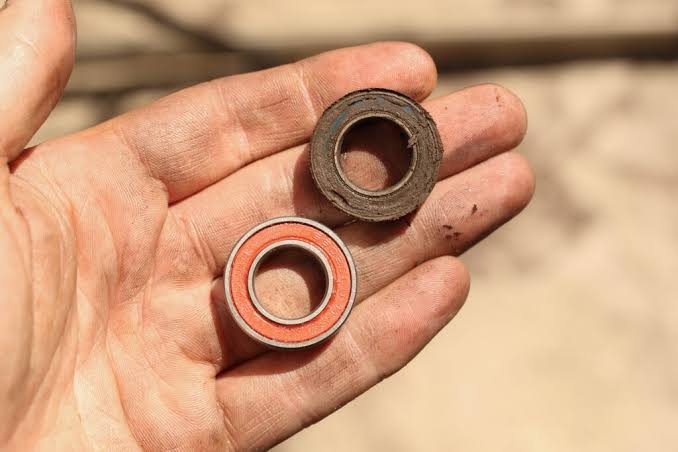
If you've ever gone hunting through a parts drawer for a replacement bearing and found yourself staring at a worn-out number like "6204 2RS C3" wondering what on earth it means, you're not alone. The 6000 series is the bearing world's bread and butter — chances are there's one spinning away right now in your workshop compressor, your ute's alternator, a conveyor idler on the line, or the pump out the back of the shed. Here in New Zealand, where machinery gets worked hard across farms, freezing works, forestry gear and factory floors, understanding this little bearing family can save you a callout, a breakdown, or a very awkward conversation with the boss about downtime.
This guide walks through what 6000 series bearings actually are, how to read the numbers stamped on the side, what all those extra letters mean, and how to choose the right one for your application — whether you're maintaining a dairy shed vat, a fishing boat winch, or the office aircon fan.
What Is a 6000 Series Bearing?
A 6000 series bearing is a type of deep groove ball bearing — the most common rolling element bearing made anywhere in the world. It's built from two rings (an inner ring that sits on the shaft and an outer ring that sits in the housing), a set of hardened steel balls running in a groove machined into each ring, and a cage that keeps those balls evenly spaced as they roll.
The "deep groove" bit refers to the shape of that groove. Because it's cut deep into the ring rather than shallow, the bearing can happily carry load from the side (radial load) and a reasonable amount of load pushing along the shaft (axial or thrust load) at the same time. That dual capability is exactly why deep groove ball bearings turn up absolutely everywhere — they're the general-purpose workhorse of the bearing world, doing the job that two separate specialised bearings would otherwise need to do.
Under the international standard (ISO 15 / DIN 625), any bearing whose designation starts with a "6" is a single-row deep groove ball bearing. The 6000, 6200, 6300 and 6400 families all fall under this umbrella — they're just different "weight classes" of the same basic design.
Why 6000 Series Bearings Are So Widely Used
There are a handful of practical reasons this bearing shows up in nearly every machine you'll come across:
- They do two jobs at once. Radial and moderate axial load, without needing a dedicated thrust bearing bolted on alongside.
- They spin fast without complaint. Because the balls only touch the races at a point rather than along a line, friction stays low, so these bearings tolerate higher RPM than most roller-type bearings of the same size.
- They're everywhere, and interchangeable. Because the dimensions are standardised worldwide, a 6204 from one manufacturer will drop straight into a housing built for a 6204 from another. Handy when your usual supplier is out of stock and you need the machine running before smoko.
- They're affordable. Because they're manufactured in huge volumes, the humble 6000 series is one of the cheapest ways to support a rotating shaft.
- They're low-maintenance. Sealed and shielded versions come pre-greased from the factory and are genuinely fit-and-forget for years.
The trade-off is load capacity for size. A 6000 series bearing carries less load, millimetre for millimetre, than a roller bearing of similar dimensions. So where the shaft is skinny but the load is heavy, you'll often see a roller or tapered roller bearing doing the job instead. For the vast bulk of general rotating machinery, though, the 6000 series is the right starting point.
The Four Dimension Series: 6000, 6200, 6300 and 6400
Here's where a bit of confusion often creeps in. "6000 series" gets used loosely by a lot of people to mean deep groove ball bearings generally, but strictly speaking it refers to one specific weight class within that family — the lightest one. There are four dimension series, each sharing the same bore for a given size code but with a different outer diameter and width, which changes how much load they can take.
|
Series |
AKA |
Cross-section |
Load capacity |
Where you'll find it |
|
6000 |
Extra light |
Slimmest of the four |
Lowest |
Compact motors, instruments, packaging gear |
|
6200 |
Light |
Standard, most common |
Baseline |
Fans, general electric motors, gearboxes |
|
6300 |
Medium |
Noticeably chunkier |
~50% more than 6200 |
Pumps, ag machinery, conveyor pulleys |
|
6400 |
Heavy |
Heaviest of the four |
Highest |
Heavy industrial, mining, marine gear |
Here's the catch a lot of people trip over: a 6204 (6200 series, 20 mm bore) and a 6304 (6300 series, 20 mm bore) share the same bore, but the 6304 has a bigger outside diameter and is wider. Fit a 6204 where a 6304 should go and you'll be left with a sloppy fit in the housing. Get them mixed up and it either won't go in at all, or it'll sit loose and hammer itself to bits within a few weeks.
If you're not sure which series the original was, the safest bet is always to read the part number off the old bearing before it's binned.
Cracking the Code: What Do the Numbers and Letters Mean?
Once you know the system, decoding a bearing stamp is straightforward. Take a typical example: 6204-2RS-C3.
First digit (6): Confirms it's a single-row deep groove ball bearing.
Second digit (2): The dimension series — 0 for extra light, 2 for light, 3 for medium, 4 for heavy.
Last two digits (04): The bore size code. For codes 04 and above, multiply by 5 to get the bore in millimetres. So 04 = 20 mm, 05 = 25 mm, 06 = 30 mm, and so on. Codes below 04 are irregular: 00 = 10 mm, 01 = 12 mm, 02 = 15 mm, 03 = 17 mm.
|
Bore code |
Bore (mm) |
|
00 |
10 |
|
01 |
12 |
|
02 |
15 |
|
03 |
17 |
|
04 |
20 |
|
05 |
25 |
|
06 |
30 |
|
07 |
35 |
|
08 |
40 |
|
09 |
45 |
|
10 |
50 |
Suffixes: Everything after the four core digits describes the extras — seal type, internal clearance, and sometimes cage material or precision grade. We'll cover the two most useful ones below: sealing and clearance.
Open, Shielded or Sealed: Picking the Right Protection
This is probably the single most common question we get asked over the counter, and it comes down to matching the bearing to the environment it'll actually be living in.
Open (no suffix): No shields or seals at all. The bearing relies entirely on the housing or an external seal arrangement to keep grease in and muck out. Cheapest option, and fine where the bearing sits in an oil bath or a grease-packed housing that does the sealing job for it.
Shielded (Z or ZZ): A thin pressed-steel shield sits close to the inner ring but doesn't actually touch it. This keeps out coarse dirt and swarf while running almost as freely as an open bearing — low friction, high RPM. It won't stop fine dust or water getting in, though. This is the standard choice for clean, dry indoor industrial use.
Sealed (RS, 2RS): A rubber lip makes actual contact with the inner ring, giving genuine sealing against dust, moisture and wash-down water. The trade-off is a touch more friction and a slightly lower top speed than a shielded equivalent. If the bearing's going anywhere near a wash-down area, a milking shed, a boat, or an outdoor yard, 2RS is the one to reach for.
|
Type |
Friction |
Protection |
Best suited to |
|
Open |
Lowest |
Relies on housing/system |
Oil-bath or grease-packed housings |
|
Shielded (ZZ) |
Low |
Coarse dirt only |
Clean, dry indoor machinery |
|
Sealed (2RS) |
Slightly higher |
Dust, water, wash-down |
Ag, marine, food processing, outdoors |
Internal Clearance: What's C3 All About?
Internal clearance refers to the tiny bit of "play" designed into a bearing before it's ever fitted. It sounds counter-intuitive — surely you want it tight? — but that clearance is there on purpose, to give the bearing room to expand as it heats up during operation without seizing solid.
- C2 — tighter than standard. Reserved for precision equipment where tolerances matter more than heat.
- CN (standard, often no code at all) — the general-purpose default.
- C3 — a bit looser than standard. The go-to for electric motors and anything that runs continuously and builds up heat.
- C4 — looser again, for heavy-duty continuous running with bigger thermal swings.
Here's the practical bit: on an electric motor, the shaft and inner ring heat up faster than the outer ring sitting in the (cooler) housing. As the inner ring expands, that built-in clearance shrinks. Start with standard clearance on a motor and it can tighten right up and cook itself. That's why C3 has become the default across the industry for motor bearings — if you're replacing a bearing on a motor or a piece of continuously running gear and can't read the old clearance code, C3 is the safe bet.
Common 6000 and 6200 Series Sizes
A quick-reference table for the sizes that turn up most often across New Zealand workshops, farms and factories:
|
Code |
Bore (mm) |
O.D.(mm) |
Width (mm) |
Common uses |
|
6000 |
10 |
26 |
8 |
Small motors, compact gear |
|
6201 |
12 |
32 |
10 |
Light motors, packaging equipment |
|
6202 |
15 |
35 |
11 |
Fans, light industrial |
|
6203 |
17 |
40 |
12 |
General motors, light industrial |
|
6204 |
20 |
47 |
14 |
Motors, gearboxes, fans |
|
6205 |
25 |
52 |
15 |
General industrial, light-medium load |
|
6206 |
30 |
62 |
16 |
Pump shafts, conveyor idlers |
|
6207 |
35 |
72 |
17 |
Medium industrial gearboxes |
|
6208 |
40 |
80 |
18 |
Industrial gearboxes, pumps |
If you're not sure of the size in hand, measure the bore, the outside diameter and the width with a set of calipers and match it against the table — that'll get you 90% of the way there even with the markings worn off.
Fitting and Removing 6000 Series Bearings
A few things worth knowing before you reach for the hammer (please don't reach for the hammer):
- The inner ring is usually an interference fit on the shaft — it should need to be pressed or heated on, not tapped with a socket and a lump hammer.
- The outer ring is normally a slip fit in the housing, loose enough to allow slight axial movement as the shaft heats and expands.
- Always press or drive on the ring that's actually being fitted. Pressing on the outer ring to seat the inner ring — or vice versa — sends the load straight through the balls and can brinell the races before the bearing's even turned a revolution.
- An induction bearing heater is the tidiest way to fit a bearing onto a shaft; failing that, a controlled oil bath works. Avoid an open flame — it's very easy to overheat the races and ruin the hardening.
- For removal, use a proper bearing puller matched to the access you've got — external jaw puller, internal (blind-hole) puller, or a slide hammer where there's nothing to grip from outside.
Spotting a Bearing on Its Way Out
Most bearing failures give some warning if you know what to listen and feel for:
- A steady hum or grumble that wasn't there before often means pitting or spalling on the raceway — usually the beginning of the end.
- A sharp click or knock on rotation can mean the cage has let go, or there's a chip in a race — don't run it any further than you have to.
- A high-pitched whine points to inadequate or wrong-grade grease.
- Visible grease weeping or a dry, dusty bearing on a sealed unit usually means the seal's had it.
- Bluish or straw-coloured discolouration on the rings means the bearing has run hot enough to soften the steel — replace it, and work out why it got that hot in the first place.
Catching these signs early is the difference between a planned five-minute swap on a Friday afternoon and an unplanned three-hour shutdown mid-shift.
Choosing the Right Bearing for New Zealand Conditions
A few things specific to working across New Zealand are worth keeping in mind:
- Dairy sheds, wash-down areas and coastal/marine environments call for 2RS sealed bearings as standard — the extra sealing more than pays for itself against moisture and washdown chemicals.
- General workshop and factory machinery running indoors in a reasonably clean environment is well served by ZZ shielded bearings — lower friction, longer bearing life at higher RPM, and no maintenance required.
- Ag and forestry equipment exposed to grit, sawdust and mud benefit from sealed bearings and more frequent inspection intervals than an indoor equivalent.
- Electric motor replacements should default to C3 clearance unless you can confirm the original spec was different.
- When replacing a bearing on imported machinery, match the original brand and suffix where you can — particularly if the gear is still under warranty.
Final Checklist Before You Order
- Read the full part number off the old bearing, including all suffixes
- Confirm bore, OD and width if the markings are gone
- Match the dimension series (6000 vs 6200 vs 6300 vs 6400) — don't assume
- Decide on seal type based on the environment: open, ZZ, or 2RS
- Check internal clearance — default to C3 on motors if unknown
- Fit correctly: press or heat onto the correct ring, never hammer the outer race through the balls
Getting a bearing wrong by even one digit or letter can mean a bearing that doesn't fit, doesn't seal properly, or cooks itself within a season. Getting it right means years of trouble-free running.
If you've got an old, worn-out bearing with no visible markings, or you're speccing something for a new build, our team can help match it up — metric and imperial, from the compact 6000 series right through to heavy-duty 6300 and 6400 sizes. Send us an email.
Cheers, Mike