
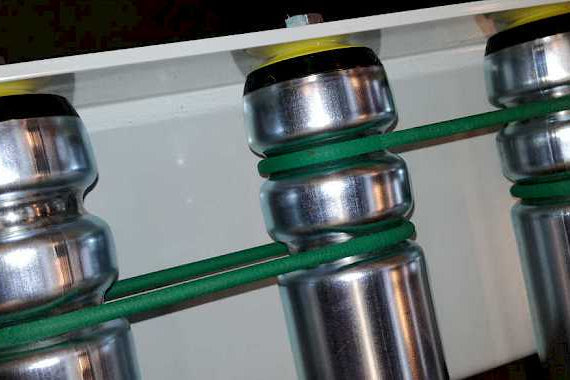
The conveyor has stopped, and a small round belt driving the rollers has broken. This guide covers what that belt is, how to identify a replacement, whether it can be repaired, and how to get the conveyor running again.
If you're looking for a replacement for the wide belt that carries product along a conveyor, this isn't it — that's a different type of belting entirely. This guide is specifically about the small round belts used to transmit drive between conveyor rollers, most commonly found on roller conveyors and line-shaft conveyor systems. RR Fisher's range is here.
Is This the Belt You're Looking For?
Round drive belts sit between or around the conveyor rollers, not on top of them. They're typically 2–12.5 mm in diameter, run in a circular cross-section (unlike the flat belts that carry product), and are commonly red, orange or green.
Common signs you've got the right belt:
· It runs roller-to-roller, or roller-to-drive-shaft, rather than carrying product
· It has a round, not flat, cross-section
· It's on a roller or line-shaft conveyor
· It's snapped, stretched, glazed, or come off its path
Colour alone doesn't identify the belt. It's tempting to assume orange means one material and red means one brand, but colour is just a visual clue — diameter, construction and application matter far more when selecting a replacement. Don't rely on colour to specify a replacement belt.
One thing that makes round belts a good fit for this kind of drive: they're elastic enough to install without a separate tensioning device, which is part of why they're so widely used between conveyor rollers. It's also worth checking that the belt is running in a pulley or roller groove designed for round-section belt — round belt run in a V-belt groove will wear and slip faster than it should, regardless of how good the belt itself is.
You may hear this component called a round belt, round-section belt, polyurethane round belting, round drive belt, polycord, urethane round belt, polyurethane belt cord, conveyor roller belt, or line-shaft conveyor belt. These terms are often used interchangeably by different people in different industries, and they don't always refer to an identical product in every application — so don't assume a single name pins down an exact specification.

Why Do Conveyor Round Belts Break?
Round belts fail for a handful of recurring reasons: age and fatigue, excessive tension, a seized or hard-to-turn roller putting extra load on the belt, contamination or misalignment causing abrasion, or simply the wrong specification for the application in the first place. A broken belt is often a symptom rather than the root cause — more on that below.:
How to Identify the Correct Replacement Belt:
Work through these steps before you order anything.
1. Measure the diameter: The figure you need is the diameter of the round cord itself, not the circumference. Digital or vernier calipers give the most reliable reading — measure the belt (or a good offcut of it) at a couple of points, since a worn belt can measure slightly under its original size.
2. Check whether it's solid or hollow: Round belts come in solid and hollow construction. Hollow belts have a bore running through the centre. Check which type is fitted before ordering — a solid belt and a hollow belt of the same outer diameter are not interchangeable in every application.
3. Check the surface: Look at whether the belt surface is smooth or has a rough/textured finish. Surface finish affects grip against the rollers it drives, so match what's currently fitted unless you have a specific reason to change it.
4. Determine the required length: Don't assume the length of the broken belt is automatically the correct replacement length — a belt that has stretched, been re-tensioned over time, or was cut slightly long or short originally won't give you an accurate figure. Where possible, measure the actual running path around the rollers, or calculate it from centre distances and roller diameters.
5. Photograph the conveyor and belt: Take a photo of the whole conveyor, a close-up of the belt, a shot showing how it runs around the rollers, and any visible markings, along with your measured diameter. This is the fastest way to get help identifying a suitable replacement if you're not confident on any of the steps above.
Can You Join a Polyurethane Round Belt?
Yes — polyurethane round belting can be joined to form an endless belt, where the belt and application suit it and an appropriate joining method is used.
Buying by the metre. Round belt is commonly sold by the metre rather than as a pre-made endless loop. That means you buy the length you need and join the ends on site, which is useful when you need the conveyor back up quickly or when a non-standard length is required. It doesn't mean every application should be repaired rather than replaced with a new endless belt — that depends on the condition of the existing belt and the failure you're dealing with.
Joining methods. Two general approaches are used for round belts: heat welding the ends together to form a continuous belt, and mechanical fastening, where a fastener joins the two ends without welding. Not every fastener suits every belt diameter or application, and not every belt is a good candidate for welding on site without the right equipment. If you're welding polyurethane round belt, this is a job for the correct tooling and technique for the specific belt material — it's not something to improvise, and getting it wrong produces a joint that's weaker than the belt itself.
On the welding side, unreinforced belts are typically butt welded end-to-end, while reinforced belts use an overlap weld. Guidance puts the welding temperature for polyurethane belts at around 290°C and polyester (TPE) belts at around 240°C, with purpose-built welding tools used to hold that temperature consistently. Treat these as a manufacturer reference point rather than a universal setting — always follow the specific belt or equipment manufacturer's instructions for the material you're actually working with.
Fasteners. Fasteners are typically used with hollow round belt, where the fastener's nipple fitting connects into the bore running through the belt's centre rather than requiring a weld. RR Fisher stocks Beha fasteners for selected round belt sizes, including 4.8 mm, 6.3 mm, 8 mm, 9.5 mm and 12.5 mm. These are matched to specific belt diameters, so check the fastener size against your measured belt diameter before ordering.
Join or replace?
Joining the existing or a new length of belt can make sense when downtime needs to be minimised, the belt (or a fresh length of the correct belt) is otherwise suitable for the job, and you can establish the required length with confidence.
Full replacement is usually the better call when the existing belt is old, shows multiple signs of wear or deterioration, the specification is uncertain, or the same belt keeps failing repeatedly — in that case, a join is likely to fail again for the same underlying reason.
How to Replace a Broken Conveyor Roller Belt
· Isolate the conveyor and follow your site's lockout/tagout and safety procedures before touching anything.
· Remove the failed belt.
· Inspect the rollers it was driving.
· Check that the rollers spin freely by hand — resistance here is a warning sign, not just a symptom.
· Check bearings and any other components in the drive path for wear or damage.
· Check the belt path and alignment around the rollers.
· Confirm the replacement belt specification: diameter, solid or hollow, surface, and length.
· Install the belt, or join it to length using the appropriate method.
· Check tension once fitted.
· Run the conveyor and observe the belt in operation before leaving it unattended.
Don't simply fit a new belt without checking why the old one failed. If a roller was seized or a bearing was damaged, a new belt fitted onto the same fault will fail again — sometimes quickly.
Why Does My Conveyor Round Belt Keep Slipping?
|
What you see |
Possible cause |
|
Belt has snapped |
Age, fatigue, excessive tension, or another mechanical issue |
|
Belt is worn or thinned |
Abrasion or rubbing against another surface |
|
Belt appears melted or glazed |
Excessive friction, ongoing slippage, or another mechanical issue |
|
Joint has failed |
Unsuitable joining method, or a joint not suited to the application |
|
Belt keeps coming off the rollers |
Alignment or belt-path issue |
|
Belt stretches excessively |
Incorrect specification or incorrect tension |
|
New belt fails quickly |
Seized roller, excessive tension, overload, or wrong specification |
|
Belt wears quickly even when new |
Running in a pulley or roller groove not shaped for round-section belt |
Slipping specifically tends to come down to insufficient tension, a worn or glazed belt, the wrong belt specification for the load, contamination on the belt or roller surface, misalignment, a mismatched pulley groove, or a roller that's harder to turn than it should be.
If a roller is difficult to turn or has seized, simply increasing belt tension isn't a proper fix. It may get the conveyor moving in the short term, but it puts extra load on a belt that's already fighting resistance it shouldn't have to, and tends to accelerate the next failure.
Why Did My Conveyor Belt Break Again?
A broken belt is sometimes a symptom, not the root cause. If a belt has failed more than once, it's worth stepping back and checking the rollers, bearings, alignment, belt path, tension, load, and the surrounding components before fitting another replacement — otherwise you're likely to be back here again shortly.
What Brand Is My Conveyor Belt?
The belt fitted to your conveyor may be branded Beha, Redthane, or something else again — but you don't necessarily need to know the original brand to start identifying a replacement. What actually matters for sourcing a replacement is diameter, construction (solid or hollow), surface finish, application, and how it needs to be joined — not the name printed on the original.
Choosing the Right Replacement Round Belt
RR Fisher's polyurethane round belt range covers both solid and hollow construction, sold by the metre, in a range of diameters currently including 2 mm, 3 mm, 4 mm, 4.8 mm, 5 mm, 6 mm, 6.3 mm, 8 mm, 9.5 mm, 10 mm and 12 mm, in smooth and rough surface finishes. These are the sizes currently stocked — treat this as a starting point for what's available rather than a claim that one of these will fit every conveyor. Matching fasteners are stocked for selected diameters where a mechanical join is the right approach.
For context, round belt as a product category is generally manufactured from around 2 mm up to 20 mm diameter, with 3–8 mm the most commonly used range and 10–20 mm reserved for higher-load applications. If your measured diameter falls well outside RR Fisher's current stocked range, get in touch — it's worth confirming rather than assuming a suitable option isn't available.
Not Sure Which Belt You Need?
If you're not sure what you've got, don't guess. Send RR Fisher a photo of the conveyor, a close-up of the belt, a shot of how it runs around the rollers, and the measured belt diameter — the approximate length too, if you know it. From there, we can help work out what you're looking at and what replacement options are suitable.
Contact RR Fisher on 0800 235 877 or get in touch here.