
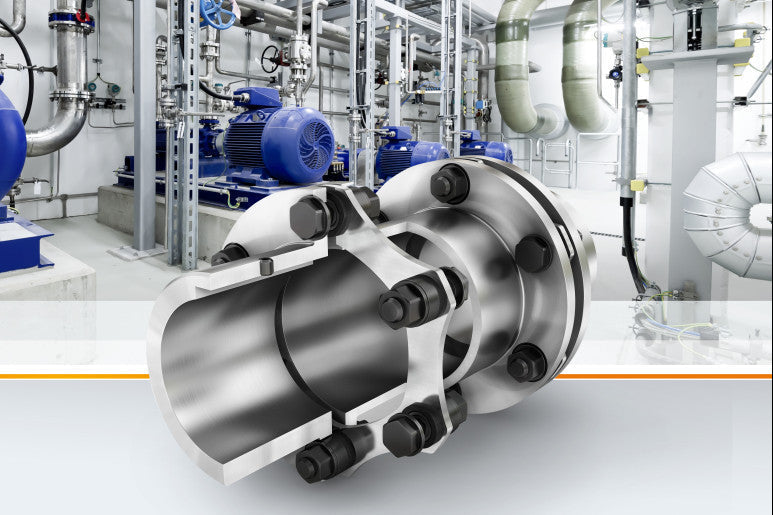
During routine inspections it's not uncommon to find worn elastomer blocks, cracked elements, damaged plate packs, excessive movement, or other signs that a coupling is approaching the end of its service life.
For many industrial sites, the best time to identify and order replacement coupling components is before they're needed urgently. Some Flender coupling parts can have extended lead times, making forward planning an important part of avoiding unplanned downtime.
In this guide we'll show you how to identify your Flender coupling, where to find the model information, what measurements may be required, and what details to send RR Fisher so we can help source the correct replacement parts. RR Fisher is Flender's authorised New Zealand distributor and the best company positioned to help you with your coupling needs.
What Is a Flender Coupling?
Flender (Formerly owned by Siemens) is one of the longer-standing names in mechanical drive couplings, and you'll find their gear right across New Zealand industry — dairy processing plants, steel mills, sawmills, cement works, pump stations, you name it. A coupling's job is simple in concept: connect a driving shaft (motor, gearbox, engine) to a driven shaft (pump, fan, conveyor, agitator) so torque gets transmitted cleanly, while coping with a bit of misalignment, vibration, or shock loading along the way.
Flender builds couplings across several families, each suited to a different job — flexible, highly flexible, torsionally rigid, hydrodynamic, and application-specific designs for things like railway vehicles and wind turbines. Getting a replacement right starts with knowing which family your coupling belongs to.
If you're in a dairy factory there's a good chance your coupling arrived as part of a package from an OEM rather than direct from Flender, which means the plant's own documentation might only reference the OEM's equipment number rather than the coupling itself. More on working around that below.
Common Flender Coupling Types Found in Industry
N-EUPEX (flexible pin coupling) — A cast iron coupling using rubber pins to absorb misalignment and shock. Common on pumps, fans, compressors, agitators and mixers. If your coupling has a ring of rubber-sleeved pins between two hubs, it is often an N-EUPEX design.

N-BIPEX (Flexible Elastomer Coupling)— N-BIPEX couplings use elastomer buffers to provide torsional flexibility while maintaining a compact design. They are commonly used on electric motor drives, conveyors, pumps and general industrial machinery where vibration damping and reliable torque transmission are required. Compared with N-EUPEX couplings, N-BIPEX units are often found in more compact installations and higher-speed applications

RUPEX (pin-and-bush coupling) — Built for medium-to-high torque, harsher duty applications: conveyors, cranes, screw pumps, cement mixers. Rated from around 200 Nm up to 1,300,000 Nm, so this covers everything from small process drives to serious heavy industry.

ARPEX and N-ARPEX (all-steel couplings) — Compact, torsionally rigid, and used where precision and a good power-to-weight ratio matter: turbines, compressors, high-speed drives. No rubber elements to wear out, but alignment tolerances are tighter.

ZAPEX (gear couplings) — Oil or grease-lubricated gear couplings for high torque transmission, seen on paper machines, cement mixers, agitators and heavy conveyor drives, right up to 7,200,000 Nm rated torque.

FLUDEX (hydrodynamic fluid couplings) — Works on the Föttinger (fluid) principle rather than a mechanical connection, giving smooth soft-start and overload protection. Common on conveyors, mixers and pumps that need a gentle start-up.

If you're not sure which of these you're looking at, don't stress — a couple of clear photos (see below) will usually let us pick it in a few minutes. RR Fisher holds some Flender Coupling sizes and elastomers ex-stock. Search the range here.
How to Identify Your Flender Coupling
Start with the visual basics:
- Rubber elements visible? Likely N-EUPEX, N-BIPEX, ELPEX or ELPEX-B — a flexible or highly flexible type.
- All metal, compact, bolted flange design, no rubber? Likely ARPEX or N-ARPEX.
- Gear teeth visible inside a lubricated housing, sometimes with grease nipples? Likely a ZAPEX gear coupling.
- A sealed housing with an oil fill plug and no visible hubs? You've probably got a FLUDEX fluid coupling.
- Pins with individual rubber bushes running through both hub flanges? RUPEX.
Next, have a look for a nameplate or stamped marking on the coupling housing or hub — these are often small and grubby after years in service, so a rag and a torch (and maybe a wire brush, gently) go a long way. Genuine Flender parts are usually stamped or plated with the coupling type designation (e.g. "N-EUPEX B") and a size number.
Where to Find the Flender Model Number
A few places worth checking, roughly in order of how likely they are to pay off:
- The coupling itself — a stamped or engraved nameplate on the hub or guard, often on the outer face or rim.
- The MLFB number — Flender products carry an MLFB (a Siemens-style material number, e.g. something like "2LC0170-4AB11-0AA0"). If you can find this, it's the single fastest way for us to confirm the exact part.
- Original equipment or drive-train drawings — GA drawings, drive schedules or spare parts lists from the original installation, if your plant's engineering files go back that far.
- The pump, fan, gearbox or motor supplier's documentation — particularly relevant in dairy processing, where the coupling often came bundled inside a skid or module supplied by an OEM. Their equipment number or bill of materials may reference the Flender part even though your plant records only show the OEM's own tag number.
- Site maintenance history — work orders, old purchase records, or a previous supplier's invoice can all point back to the right part.
If none of that turns anything up — genuinely common in older plants, or where a coupling's been through a rebuild that lost its paperwork — that's fine. This is exactly what the measurements and photos below are for.
What Measurements Are Needed?
Even without a model number, we can usually match a coupling from dimensions and torque requirements. Where possible, gather:
- Bore diameter for each hub (driving side and driven side — they're not always the same)
- Keyway dimensions — width, depth, and whether it's a standard parallel key
- Overall coupling diameter (OD) and overall length across both hubs
- Hub length on each side
- Number and size of any bolts, pins, or elastomer elements, if visible or countable
- Shaft-to-shaft distance (DBSE) where relevant, particularly for spacer-type couplings
- Motor/driven equipment power (kW) and running speed (RPM) — this lets us cross-check the coupling's rated torque is adequate for the application, not just physically the right size
A tape measure and vernier callipers will cover most of this. If the coupling's still fitted and running, take what you safely can without pulling the drive apart — we can usually fill gaps once we've seen photos and any model number fragment.
Photos We Recommend Sending
Photos do a lot of heavy lifting here, especially when a nameplate's worn off or was never fitted. Useful shots include:
- A wide shot of the whole coupling in situ, showing both hubs and the guard if fitted
- A close-up of any nameplate, stamped marking, or MLFB number, even if partly worn
- Both hub faces, ideally with a tape measure or ruler in shot for scale
- The bore and keyway, if the coupling is off the shaft
- Any damaged components — this helps us confirm the failure mode and check whether anything else on the drive train needs a look
- The driven and driving equipment nameplates (pump, motor, gearbox) if you're not sure of power and speed
Good lighting and a phone camera are all you need — no need for anything fancy.
Common Reasons Couplings Need Replacing
Couplings are a wear item by design in a lot of applications — the flexible element is meant to be the sacrificial part that protects your pump, motor or gearbox from shock loads. Typical reasons we see couplings come in for replacement:
- Perished or torn rubber elements in N-EUPEX, N-BIPEX and ELPEX types, usually from age, heat, or chemical exposure (common in wash-down environments like dairy processing)
- Misalignment wear, where a coupling's been quietly compensating for a drive that was never lined up properly, accelerating wear on pins, bushes or elastomers
- Fatigue cracking in all-steel ARPEX/N-ARPEX couplings under sustained high torque or vibration
- Corrosion, particularly in washdown or coastal environments common across New Zealand food and beverage sites
- Overload or shock failure, where a jam, blockage or process upset has sheared pins or torn elements outright
- General end-of-service-life replacement as part of planned maintenance, particularly on critical drives where unplanned downtime is expensive
Information RR Fisher Needs to Quote a Replacement
To get you an accurate quote with minimum back-and-forth, send through as much of the following as you can:
- Coupling type/model, if identified (e.g. N-EUPEX, RUPEX, ARPEX)
- MLFB number, if visible
- Bore sizes and keyway dimensions for both hubs
- Overall dimensions (OD, length, hub lengths, shaft separation if applicable)
- Motor/driven equipment power (kW) and speed (RPM)
- Photos as outlined above
- The application (pump, fan, agitator, conveyor, etc.) and site environment (washdown, dusty, outdoors, high ambient temperature)
- Whether it's urgent — we understand that in most cases, it is
The more of this you can supply, the fewer follow-up questions we'll need to ask before getting pricing and lead time back to you.
Need Help Identifying Your Flender Coupling?
If you're standing next to a coupling with a worn nameplate and half the puzzle missing, that's a normal Tuesday for us. Whether it's a straightforward N-EUPEX off a dairy factory pump, a RUPEX from a conveyor drive at the sawmill, or an all-steel ARPEX out of a steelworks gearbox, send through what you've got — photos, dimensions, whatever paperwork survives — and RR Fisher will work through the rest with you to get the correct replacement sorted and back on site fast.
Get in touch with the team at RR Fisher on 0800 235 877 or email at sales@rrfisher.co.nz and we'll get your coupling identified and quoted. A contact form can be found here.