
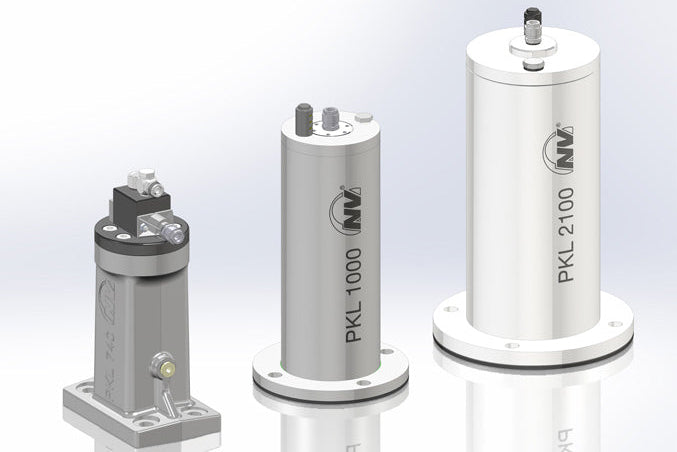
The PKL series from NetterVibration and represented in New Zealand by RR Fisher, is a proven line of pneumatic impactors engineered to resolve material flow challenges in silos, hoppers, pipes, and containers. Their core strength lies in delivering a powerful “hammer-like” strike to dislodge stubborn, stuck material: bridging, rat-holes, clogging or blockages inside bins, chutes, or containers get knocked loose so the contents flow freely.
Here's how it works: compressed air drives a piston against one or two springs, then the air chamber vents rapidly — releasing the spring energy and shooting the piston against the impact surface (directly or via an impact plate, depending on the PKL model).
Compared to traditional impactors, the PKL line offers several advantages:
· Higher impact power — effective even on stubborn residues.
· Lower compressed-air consumption per impact — efficient use of energy.
· Compact, rugged design suitable for industrial installations.
· Low maintenance and long lifespan, making them cost-effective over time.
Typical uses include: cleaning pipes, bunkers, tanks or containers; removing tube-forming or bridging of bulk solids; ensuring complete emptying of hoppers; restoring flowability of powders, grains, salts, aggregates — basically any bulk-material application where material sticks or clumps.
PKL Models — From Small to Heavy-Duty
The PKL series comes in a range of models to fit different application needs — from small hoppers to large silos. Among the models: PKL 190, 450, 740 (compact units that hit directly on the mounting surface) and larger PKL 1000, 2100, 5000, 10000 (which hit via an impact plate). Shop online with pricing and availability found here.
The choice of model depends on factors such as container size, material type, required impact energy, and mounting surface. Using the right model ensures peak performance and durable installation.

Accessories & Add-Ons — Customising Your PKL for Performance
One of the strengths of the PKL system is the wide range of optional accessories and upgrades that adapt the impactor to different working conditions and needs. Here’s a breakdown of what you can pair with your PKL.
Essential Mounting & Fixing
NBS Fastening Sets — These are mandatory screw and fixing kits for secure, safe mounting of PKL impactors. There are different versions: NBS G (for threaded holes), NBS D (for through holes), and stainless-steel variants for corrosive environments. This fixing set helps buffer impact reaction forces, ensuring safe and stable operation — and is required to preserve warranty.

Weld-On Consoles / Weld-On Plates / Glueing Consoles — For permanent mounting on container walls. For metal containers or silos, welding ensures a robust base for the impactor. For other surfaces, glueing consoles are available.

Control & Operation Accessories
Way-Valves (Pneumatic, Electric or Manual) — Required for actuation of the PKL. The standard operation needs a directional control valve (not included with the impactor).
Maintenance Units (Filter, Regulator, Mist Lubricator) — Because PKL uses compressed air (or nitrogen), a properly prepared air supply is critical: filtered (≤ 5 µm), with mist-lubrication, to keep piston and seals working reliably and extend service life.
Air Hoses and Hose Connections — Available in different qualities and dimensions to suit air supply setups.
Non-Return Throttle Valves — Especially used when PKL is fitted with the ST kit (see below), to control the impact frequency and ensure safe operation.

Electronic/Pneumatic Timers (e.g. AP Timer) — For clock-controlled operation: impact sequences can be automated rather than manually triggered. Useful for facilities where you want regular strikes at set intervals.

Performance & Environment-Adapted Kits
ST Kit — Enables “continuous impact sequence” when connected to a permanent compressed-air supply. This is useful if you want repeated impacts (e.g. during discharge or when dealing with stubborn material) rather than intermittent manual triggering. Must be used carefully: impact frequency should respect manufacturer’s guidelines.

EE Kit (Elastomer / Rubber Hammer Kit) — Probably the best-known accessory: with the EE Kit, the PKL impactor delivers a gentler, “rubber-hammer” type impact instead of a solid steel strike. This reduces noise (by roughly 5 dB(A) for a single impact) and makes operation more neighbour- and operator-friendly — ideal when you want to maintain effective material flow but minimise decibels.

Sound Protection Hoods / Insulation Hoods — For installations where noise emission is a concern (e.g. inside buildings, near urban areas, or enclosed silos), sound-protection hoods help to dampen the impact noise and reduce disturbance.

Special Versions (Stainless Steel, High-Temperature, ATEX where needed) — Depending on the environment (corrosive materials, chemical exposure, high temperature, explosive atmospheres), Netter offers customised versions: stainless-steel housings, high-temperature tolerant (HT/NT), ATEX-compliant models, etc. Ensures compatibility with harsh industrial conditions.
Safety & Maintenance Accessories
Safety Cable — To prevent the PKL from falling in case of mounting failure. Important for overhead or awkward installations.
Damper Rings / Impact Plates / Flanges — For larger PKL models (PKL 1000 and up), proper mounting requires impact plates and damper rings to absorb the reaction force and ensure stable, safe impacts.
Why Accessories Matter — Tailoring PKL to Your Application
Using the right accessories with your PKL is not optional — it’s critical. Because the PKL delivers high-energy impacts, the fixing system must be robust to safely absorb the reaction forces. That’s why the NBS fastening sets (or weld/glue consoles) are mandatory. Without them, you risk mounting failure or even voiding warranty.
Similarly, in applications where noise is a concern — urban sites, indoor facilities, or night-time operations — using an EE kit or sound hood can dramatically improve working conditions without compromising the ability to break build-up or unblock material flow.
For high-throughput or continuous-flow operations (e.g. bulk discharge in agriculture, mining, or chemicals), adding ST kit + timer + throttle valve automates the process: no human intervention needed, just set and forget — saving time and ensuring consistent flow.
Finally, for challenging industrial environments (corrosion, chemicals, high temperature, or explosive dusts), the special variants (stainless, HT, ATEX) make PKL versatile and safe across a wide range of sectors.
PKL in Action: Typical Use Cases
- Silos & Hoppers in Agriculture or Concrete Plants — PKL knocks loose bridging and rat-holing so grain, cement or aggregate flows smoothly.
- Chemical / Fertiliser Bins — For hygroscopic powders or sticky granules: the impact breaks build-up and avoids clumping or blockages.
- Mining & Bulk Material Handling — In salt, ore or mineral transport — where material tends to compact — PKL clears out residues even after long downtimes.
- Food / Feed Processing — In bins and hoppers containing powders or grains, PKL ensures consistent discharge and reduces cleaning downtime.
- Industrial Tanks or Pipes — Helps knock off stubborn deposits inside walls or pipes, improving flow and preventing blockages.
Because of low maintenance and efficient air consumption, PKL is especially attractive in operations where frequent clearing is needed, but downtime and maintenance costs must be minimised.

Choosing and Specifying the Right PKL Setup
When specifying a PKL installation, it’s important to consider:
- Material type — sticky powders, granules, salts, aggregates, etc.
- Container shape and size — small hoppers vs large silos, straight or conical walls, presence of curved surfaces, thickness of walls.
- Required impact force — small (PKL 190/450/740) vs heavy-duty (PKL 1000+).
- Operating environment — indoors/outdoors, exposure to chemicals, temperature range, explosive dusts (ATEX).
- Noise & vibration sensitivity — are there nearby workers, residential buildings or noise limits?
- Need for automation — manual triggering vs continuous or timed impacts.
- Mounting method — welded consoles, glueing, or special mounting for curved surfaces.
- Compressed-air supply quality — clean, filtered, lubricated air; correct pressure, maintenance units, hose dimension, valve control.
By combining the right PKL model with the appropriate accessories (fastening sets, EE or ST kits, sound hoods, valves, maintenance units, etc.), you get a tailored solution that balances power, reliability, safety, and compliance.

Final Thoughts
The NetterVibration PKL series remains a benchmark in pneumatic impactors: a simple, robust design that delivers high impact force, efficient compressed-air consumption, compactness, and flexibility. With its broad accessory range, it can be configured for almost any industrial application.
Whether you need to retrofit a silo, solve chronic bridging issues in bins, or ensure consistent material flow in a demanding production environment — there’s a PKL setup to match.
Partnering with RR Fisher ensures you get the right PKL solution, complete with proper mounting, control, and dampening accessories. This not only avoids downtime but also reduces maintenance costs while improving safety and noise conditions.