
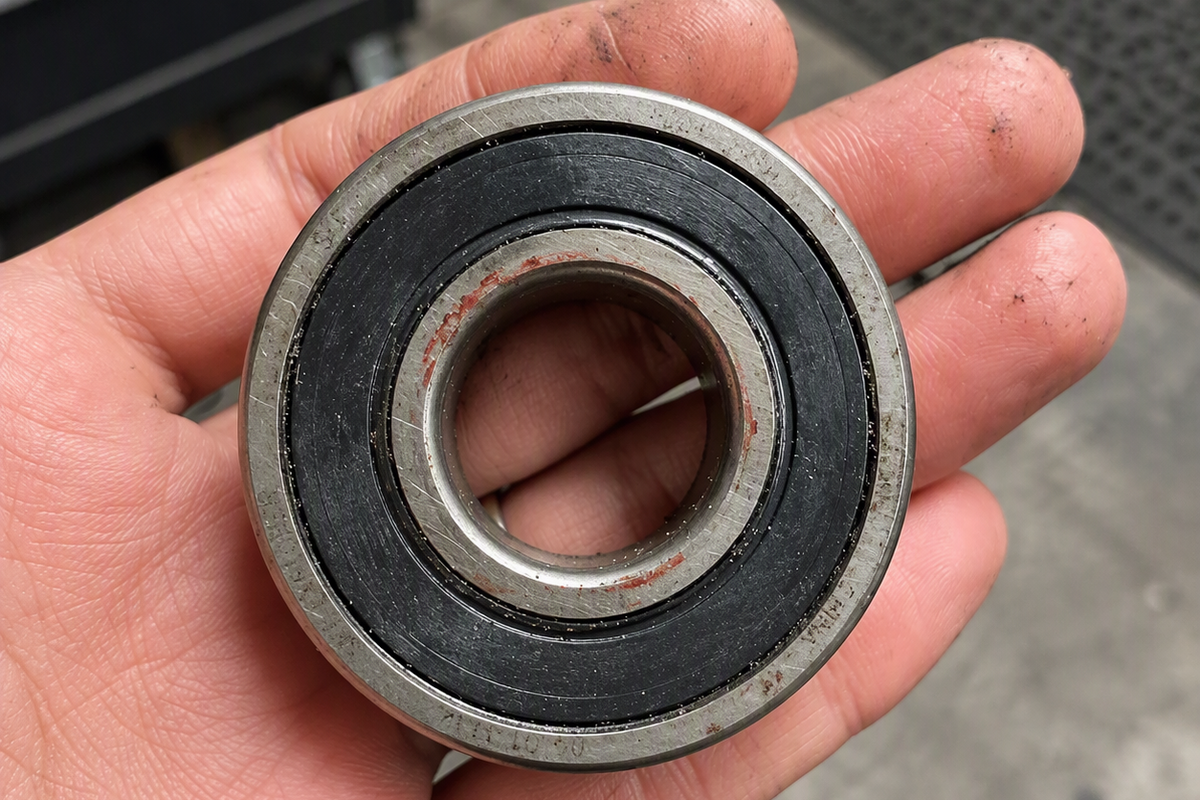
Looking for a replacement bearing in New Zealand?
Whether you're repairing a conveyor, electric motor, pump, gearbox, agricultural machine, trailer hub, or industrial equipment, choosing the correct bearing is essential for reliability, performance, and service life.
The good news is that most bearings can be identified from the bearing number or a few simple measurements. Once you've identified the bearing, choosing a replacement becomes much easier. If your ready toi go find our range here.
This guide explains:
-
How to identify a bearing
-
How bearing numbers work
-
The differences between common bearing types
-
The factors that affect bearing life
-
How to choose the right bearing for your application
What Does a Bearing Actually Do?
A rolling bearing supports a rotating shaft while allowing it to turn with as little friction as possible. Balls or rollers sit between an inner and outer ring, carrying the load while reducing sliding friction.
Every bearing selection ultimately comes down to several key factors:
Load → Speed → Fit → Alignment → Environment → Lubrication
Understand these factors and choosing the correct bearing becomes far more straightforward.
How to Identify a Bearing
Before selecting a replacement bearing, the first step is identifying the bearing currently fitted.
1. Check the Bearing Number
Most bearings have a part number marked on the outer ring, side face, or seal.
Examples include:
-
6205-2RS
-
6308-ZZ
-
22212 EK
-
UC208
A bearing designation can identify the bearing series, bore, design features and options such as seals, shields and internal clearance. The exact meaning of each part depends on the bearing manufacturer and bearing family.
If the number is still visible, this is usually the quickest and most accurate identification method.

2. Measure the Bearing
If the bearing number is damaged or unreadable, measure:
-
Inside Diameter (ID)
-
Outside Diameter (OD)
-
Width
For example:
-
25mm ID
-
52mm OD
-
15mm Width
These three dimensions are often enough to identify a standard bearing.
However, dimensions alone don't always tell you whether a bearing is the correct replacement. The bearing type, clearance, sealing, load, speed and operating conditions may also need to be checked.
3. Identify the Bearing Type
Determine whether the bearing is:
-
Deep groove ball bearing
-
Angular contact ball bearing
-
Cylindrical roller bearing
-
Tapered roller bearing
-
Spherical roller bearing
-
Needle roller bearing
-
Housed bearing unit
Different bearing types are designed to handle different combinations of load, speed and alignment.
4. Identify the Application
The machine itself can provide useful clues.
Common applications include:
-
Electric motors
-
Pumps
-
Conveyors
-
Gearboxes
-
Agricultural equipment
-
Trailer wheel hubs
-
Crushers
-
Sawmills
Knowing where the bearing is being used can help determine whether a simple like-for-like replacement is appropriate or whether other specifications need to be considered.
Understanding Common Bearing Numbers
What Does 6205-2RS C3 Mean?
A bearing number contains useful information about the bearing's design and specification.
For example:
6205-2RS C3
-
62 = Deep groove ball bearing series
-
05 = 25mm bore size
-
2RS = Rubber seals on both sides
-
C3 = Greater-than-normal internal radial clearance
Many people assume C3 means a better bearing. It doesn't.
C3 simply means the bearing has more internal clearance than a standard bearing. It can be appropriate where operating conditions, fits, temperature or other factors require additional clearance.
C3 is not automatically required simply because a bearing is used in an electric motor or high-temperature application. The correct clearance depends on the actual operating conditions.
Ball Bearings vs Roller Bearings
Ball bearings and roller bearings use different rolling elements and are suited to different applications.
Ball bearings have relatively small contact areas with the raceways, while roller bearings have a larger contact area. This generally allows roller bearings to carry higher radial loads for a given size.
However, bearing design matters. Load capacity, speed capability, friction and service life depend on the specific bearing design, lubrication, seals, internal clearance and operating conditions.
The Major Bearing Types
Deep Groove Ball Bearings
Typical ranges: 6000, 6200, 6300 series
The most widely used bearing type for general machinery.
Best suited to:
-
Predominantly radial loads
-
Moderate axial loads in either direction
-
High-speed applications
-
Electric motors, pumps, fans and general machinery
One thing worth knowing: 6200 and 6300 series bearings sharing the same bore size are not interchangeable. The series number reflects a different cross-section, including different outside diameters and widths, which affects the load rating and fit.
Always check the full designation, not just the bore size.

Angular Contact Ball Bearings
The raceways are offset at an angle, which allows the bearing to carry significant axial (thrust) load alongside radial load.
These come in single-row, double-row and paired arrangements, and may be installed with a specific preload to control internal clearance and stiffness.
Common applications: pumps, machine tools, spindles and other rotating equipment where axial load and precision matter.

Cylindrical Roller Bearings
Cylindrical roller bearings aren't simply "heavy-duty deep groove alternatives" — they're a different design family with their own configuration options, including NU, N, NJ and NUP types.
The differences between these configurations matter because they determine how axial load is handled and whether the bearing can accommodate axial displacement between the shaft and housing.
Generally offer:
-
Very high radial load capacity
-
Relatively high rigidity
-
Different flange arrangements depending on configuration
-
Designs that can accommodate axial displacement of the shaft, which can be useful for thermal expansion
-
Other configurations that can locate the shaft axially in one or both directions

Tapered Roller Bearings
The tapered geometry allows these bearings to handle radial and axial loads simultaneously — a major advantage where combined loading is present.
A tapered roller bearing consists of an inner assembly (cone) and an outer cup, which are commonly adjusted against each other to set the correct preload or endplay.
Tapered roller bearings are commonly used in opposing pairs, particularly where axial loads act in both directions. Getting the adjustment right is critical to bearing performance and life.
Common applications: wheel hubs, gearboxes and other applications with combined radial and axial loading.

Spherical Roller Bearings
Particularly relevant for heavy industrial and processing equipment.
These offer:
-
Very high radial capacity
-
Substantial axial capacity
-
The ability to accommodate angular misalignment between the shaft and housing
This last point is a major reason engineers choose a spherical roller bearing over a rigid design. Where shaft deflection, housing misalignment or mounting imprecision is likely, a spherical roller bearing can accommodate a degree of misalignment without generating the additional stress that a rigid bearing arrangement may experience.
Common applications: conveyors, crushers, screens, sawmills, quarrying and bulk handling equipment.

Needle Roller Bearings
The small roller diameter gives a high load capacity for the available radial space, making these useful where installation space is limited.
But they come with trade-offs to consider:
-
Shaft and raceway hardness and finish requirements
-
Limited axial load capability depending on the design
-
Lubrication and alignment sensitivity

Housed Bearing Units
For many applications, you're not buying a standalone bearing — you're buying a bearing insert plus a housing, and understanding the difference matters.
Common housing arrangements include:
-
UCP — pillow block housing
-
UCF — four-bolt flange
-
UCFL — two-bolt flange
The UC designation generally refers to the insert bearing series, while the remaining letters describe the housing arrangement.
For example, UCP, UCF and UCFL describe different housing styles rather than completely different types of bearing.
Housed units typically use one of:
-
Set-screw locking
-
Eccentric locking collars
-
Adapter sleeves
Consider shaft size, load, relubrication access and how much misalignment the arrangement needs to tolerate when choosing a housed bearing unit.
Don't Choose a Bearing by Size Alone
Two bearings can have the same bore, outside diameter and width but still have different specifications or be unsuitable for the same application.
When replacing a bearing, check:
-
Bearing type
-
Bore, outside diameter and width
-
Load and speed
-
Internal clearance
-
Seal or shield arrangement
-
Operating temperature
-
Lubrication
-
Shaft and housing fits
-
Alignment and misalignment
-
Any special accuracy or performance requirements
A dimensionally identical bearing is not necessarily a functionally identical bearing.
Ready to Find Your Bearing?
In many cases, identifying a bearing is simpler than people think.
If the bearing number is visible:
-
Read the bearing number.
-
Search the bearing number.
-
Confirm the bearing type and dimensions.
-
Confirm the seal or shield type (open, ZZ/2Z or 2RS).
-
Confirm any clearance requirement, such as C3.
-
Check that the replacement is suitable for the application's load, speed and operating conditions.
-
Order the replacement bearing.
If the bearing number is not readable:
-
Measure the bore (ID).
-
Measure the outside diameter (OD).
-
Measure the width.
-
Identify the bearing type if possible.
-
Use those dimensions and application details to identify the correct replacement.
Many standard bearings can be identified from the bearing number or basic dimensions. However, selecting the correct replacement may also require checking the load, speed, clearance, sealing, fit and operating environment.
Browse bearings online, compare specifications, and order with nationwide delivery throughout New Zealand.
Frequently Asked Questions
How do I identify a bearing?
The easiest method is to read the bearing number marked on the bearing. If the number is unreadable, measure the inside diameter, outside diameter and width.
What does 2RS mean on a bearing?
2RS generally indicates the bearing has rubber seals on both sides to help retain lubricant and protect the bearing from contamination.
What does ZZ or 2Z mean on a bearing?
ZZ or 2Z generally indicates metal shields on both sides of the bearing. Shields usually create less friction than contact seals but provide less protection against moisture and contamination.
What does C3 mean on a bearing?
C3 indicates greater-than-normal internal radial clearance. It can be appropriate in applications where operating temperature, fits, speed or other conditions require additional internal clearance.
Can I replace a 6205 bearing with a 6305 bearing?
No. Although both bearings have a 25mm bore, they have different outside diameters, widths and load ratings.
How do I know if a bearing needs replacing?
Common signs include:
-
Excessive noise
-
Vibration
-
Heat
-
Rough running
-
Excessive shaft movement
-
Lubricant leakage
These symptoms can also be caused by incorrect installation, lubrication problems, shaft or housing issues, misalignment or other machine problems. A noisy or hot bearing is not necessarily a bearing that has simply reached the end of its life.
Can bearing brands be interchanged?
In many cases, yes. Bearings with the same designation and specification can often be substituted between manufacturers, provided the dimensions, internal clearance, sealing and operating requirements match.
However, the bearing designation should be checked carefully because suffixes and specifications can differ between manufacturers.