
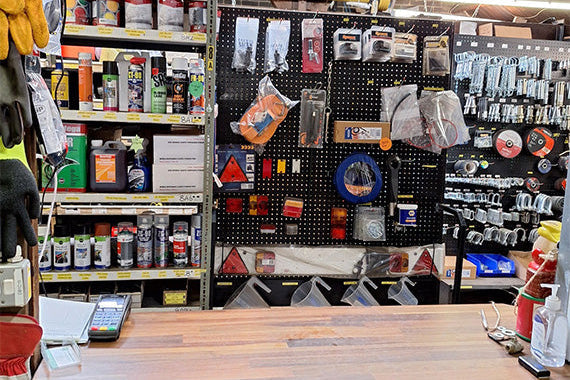
For decades, the rule in New Zealand engineering, maintenance and workshop circles was simple: when you need a bearing, belt, chain or gearbox, buy it from a local supplier.
That made sense once. If the branch down the road had it on the shelf, you could collect it immediately. If they didn't, they'd order it in and you'd wait — same as anyone else.
That second scenario is now the norm far more often than people admit. And once you're waiting on freight instead of walking to a shelf, geography stops being the thing that decides how fast your part arrives.
New Zealand Is Built for Overnight Freight
New Zealand's domestic courier networks connect hundreds of towns and cities, with overnight delivery to most urban locations and fast service to regional centres. A parcel leaving a warehouse in the afternoon can routinely reach a customer the next business day, regardless of the distance in between.
- A bearing dispatched from Hamilton can reach Gisborne tomorrow.
- A coupling sent from Christchurch can reach Nelson overnight.
- A drive belt shipped from Auckland can often reach Invercargill faster than most people expect.
Distance decides which truck or plane it travels on. It's stopped deciding how many days it takes.
What Actually Decides Your Delivery Day: The Cutoff Time
Here's the part that matters most and gets talked about least.
Every supplier has a dispatch cutoff — the time of day after which an order doesn't go out until tomorrow. Most trade counters set that cutoff early, often by early-to-mid afternoon, because their own courier collection runs through around then.
That means the real competition isn't "who's closer" — it's "whose cutoff is later." If your usual supplier closes dispatch at 2pm and you order at 2:30, you've already lost the day, no matter how many kilometres away they are. A supplier with a later cutoff — even one much further away — can still get your part moving that same afternoon and land it with you the next morning, ahead of the "local" order that missed its own window by half an hour.
Our cutoff at RR Fisher is 4pm. That's not a claim about being fast in general — it's a specific number you can hold us to, and one worth checking against whoever you currently order from.
The Trade Counter Habit
Many businesses still default to a nearby supplier because that's how the industry has always worked. The assumption: local means faster.
It's not always true. If the local supplier doesn't have the part in stock, they're ordering it from another branch or another city anyway — adding handling steps, reducing stock visibility, and often costing more, while you're still told you "bought local."
To be fair, there are jobs where being able to walk in and collect a part in the next ten minutes genuinely matters — a machine down right now, no time to wait for tomorrow's delivery. That's real, and no freight network beats a shelf you can reach on foot. But it's also a smaller share of orders than trade-counter habit assumes. Most maintenance and breakdown work already involves inspection, identification, quoting and scheduling before a part is even ordered — a day's transit time rarely changes the outcome.
What Customers Actually Need
When machinery is down, four things matter:
- Is the part in stock?
- Can someone identify it correctly?
- How fast can it be dispatched — and against what cutoff?
- When will it arrive?
Notice what's missing from that list: how close the supplier's office is.
A supplier 500 kilometres away with stock on the shelf and a 4pm cutoff is often more useful than one five minutes down the road that has to source the part from somewhere else.
How RR Fisher Serves New Zealand
Rather than a network of traditional trade counters, our model is built around:
- A large product range
- A data-rich website with real stock visibility
- Fast dispatch against a 4pm cutoff
- Nationwide freight to match
The goal: it should be just as easy to get a bearing from RR Fisher whether you're in Kaitaia, Gore, Gisborne, Westport or Te Anau.
The Future Is National
New Zealand is uniquely positioned for this. A supplier can serve customers from Cape Reinga to Bluff without needing branches everywhere — modern freight networks let a business centralise stock and hold deeper inventory while still delivering fast nationwide. For customers that means better availability, stronger technical support, more competitive pricing, and less time spent chasing suppliers.
The question engineers and procurement teams are increasingly asking isn't "who is my local supplier?" It's "who has the right part, and can get it to me fastest?"
Check Fisher first — search our site, or call before your current supplier's cutoff and see if we can still get it moving today.