
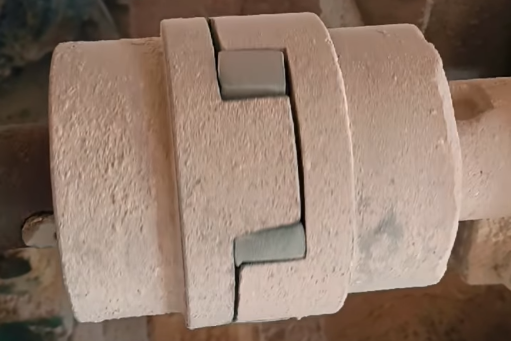
What Is a Coupling?
A coupling is a mechanical component used to connect two rotating shafts and transmit torque from a motor, gearbox, or drive system to driven equipment.
Couplings are found on conveyors, pumps, fans, compressors, mixers, manufacturing equipment, and industrial machinery. Different coupling types are designed to handle different levels of misalignment, shock loading, vibration, and torque.
If you're trying to identify an unknown coupling, start by looking at its shape, and check for visible elastomer elements, gears, chains, discs, pins, or flanges.

1. Rigid Coupling
How to identify it: A rigid coupling consists of two metal hubs bolted directly together with no flexible element between them.
Common features:
- All-metal construction
- No rubber insert
- Simple cylindrical appearance
- Usually secured with bolts or clamps
Typical applications: Line shafts, precision machinery, equipment with perfectly aligned shafts.
Advantages: High torque capacity, zero backlash, simple design.
Quick identification tip: If there is no visible flexible component and the two shafts appear permanently locked together, it's probably a rigid coupling.
2. Flexible Coupling
How to identify it: Flexible couplings contain an elastomer, spring, or flexible element between two hubs.
Common features:
- Rubber or polymer element
- Absorbs shock loads
- Reduces vibration
Typical applications: Motors, pumps, conveyors, fans.
Quick identification tip: If you can see a flexible element separating two hubs, you're likely looking at a flexible coupling.
3. Gear Coupling
How to identify it: Gear couplings use external gear teeth on the hub, typically enclosed in a sleeve or housing that keeps the mesh greased and protected.
Common features:
- Toothed hub(s)
- Usually housed and grease-filled in service
- Heavy-duty construction
Typical applications: Steel mills, mining equipment, heavy conveyors, crushers.
Quick identification tip: Visible gear teeth on the hub are the giveaway, even if the outer housing has been removed — a fully assembled gear coupling in service will normally be enclosed. RR Fisher has a range of Nylon Sleeve gear couplings which can be found here.
4. Chain Coupling
How to identify it: A chain coupling looks similar to two sprockets connected by a roller chain.
Common features:
- Duplex roller chain
- Two sprocket hubs
- Often fitted with a cover
Typical applications: Conveyors, material handling equipment, agriculture.
Quick identification tip: If it literally looks like a chain wrapped around two sprockets, it's a chain coupling. RR Fisher has a range of Chain couplings which can be found here.
5. Fluid Coupling
How to identify it: Fluid couplings are enclosed units that transfer power using hydraulic fluid.
Common features:
- Sealed housing
- Large drum-shaped body
- No direct mechanical connection between hubs
Typical applications: Conveyor drives, crushers, heavy starting loads.
Quick identification tip: A large enclosed casing with no visible flexible insert or gear teeth usually indicates a fluid coupling.
6. Oldham Coupling
How to identify it: An Oldham coupling is a three-piece design with a floating centre disc sandwiched between two hubs, used to take up parallel misalignment.
Common features:
- Central sliding disc, usually visible at the joint line
- Compact design
- Handles parallel misalignment
Typical applications: Servo systems, packaging machinery, precision equipment.
Quick identification tip: Look for a distinct middle disc between the two hubs — this is different from a standard flexible coupling, which uses a solid rubber or elastomer element rather than a sliding disc. If you can't clearly see a separate centre disc, check whether it's actually a flexible coupling instead.
7. Universal Joint
How to identify it: A universal joint uses a cross-shaped centre component.
Common features:
- U-shaped yokes
- Cross bearing assembly
- Allows angular movement
Typical applications: Driveshafts, steering systems, agricultural machinery.
Quick identification tip: The crossed centre section is unmistakable.
8. Jaw Coupling
One of the most common industrial coupling styles.
Common features:
- Three-jaw hubs
- Rubber "spider" insert
- Simple maintenance
Typical applications: Pumps, gearboxes, compressors, general industrial drives.
Quick identification tip: A visible rubber spider between two metal hubs is the giveaway. RR Fisher has a range of Jaw couplings which can be found here.

9. Disc Coupling
How to identify it: Disc couplings use thin stainless steel disc packs.
Common features:
- Thin metallic discs
- Spacer section
- No rubber components
Typical applications: Pumps, turbomachinery, high-speed equipment.
Quick identification tip: Look for stacked metal discs bolted between hubs.
10. Sleeve Coupling
The simplest coupling design.
Common features:
- Single hollow sleeve
- No moving parts
- Basic construction
Typical applications: Light-duty machinery, simple shaft connections.
Quick identification tip: It looks like a simple tube joining two shafts.
11. Muff Coupling
How to identify it: A traditional rigid coupling using a single sleeve and keys.
Common features:
- Solid sleeve construction
- Keyed shafts
- No flexibility
Typical applications: Basic mechanical drives, older equipment.
Quick identification tip: Appears as a solid cylindrical sleeve around both shafts.
12. Clamp Coupling
How to identify it: Clamp couplings use split hubs tightened with bolts.
Common features:
- Split construction
- Clamping screws
- Easy installation
Typical applications: Automation systems, precision machinery.
Quick identification tip: Visible split lines and tightening bolts along the hub.
13. Bushed Pin Coupling
How to identify it: A flange coupling fitted with rubber-bushed pins.
Common features:
- Flanges joined by pins
- Rubber bushes
- Shock absorption
Typical applications: Pumps, fans, industrial drives.
Quick identification tip: Pins passing through rubber bushes between two flanges. Check out RR Fisher's range of Bushed Pin or Cone Ring Couplings here.
14. Flange Coupling
How to identify it: Two flanges bolted directly together.
Common features:
- Circular flanges
- Bolt pattern around the outside
- Heavy-duty design
Typical applications: Pumps, marine drives, industrial equipment.
Quick identification tip: Large bolted flanges on both shaft ends.
15. Diaphragm Coupling
How to identify it: Uses flexible metal diaphragms instead of rubber elements.
Common features:
- Metallic diaphragm plates
- Precision construction
- No lubrication required
Typical applications: Turbines, compressors, high-speed drives.
Quick identification tip: Thin metal membrane sections visible between hubs.
16. Magnetic Coupling
How to identify it: Transmits torque through magnetic force without physical contact between the drive and driven sides.
Common features:
- No direct mechanical shaft connection
- Fully enclosed housing in normal use
- Leak-free operation
Typical applications: Chemical pumps, pharmaceutical equipment, food processing systems.
Quick identification tip: In service, a magnetic coupling is normally a sealed housing with no visible flexible element, gear teeth, or pins — internally, it works using colour-coded magnet segments on the drive and driven halves, which you'd only see if the unit is opened up or shown in cutaway.
Frequently Asked Questions
How do I identify a coupling? Look for the coupling's distinguishing feature — such as a rubber spider, chain, gear teeth, disc pack, pin-and-bush assembly, or flange arrangement. Measuring the shaft diameter and photographing the coupling from several angles can greatly assist identification.
What information do I need to replace a coupling? To identify or replace a coupling, provide:
- Photos of the coupling
- Shaft diameters
- Outside diameter
- Overall length
- Keyway dimensions
- Any visible part numbers
Can RR Fisher help identify a coupling? Yes. Send clear photos, shaft sizes, and any markings visible on the coupling, and our team can help identify the coupling type and recommend replacement options. You can browes the range of stocked couplings here.