
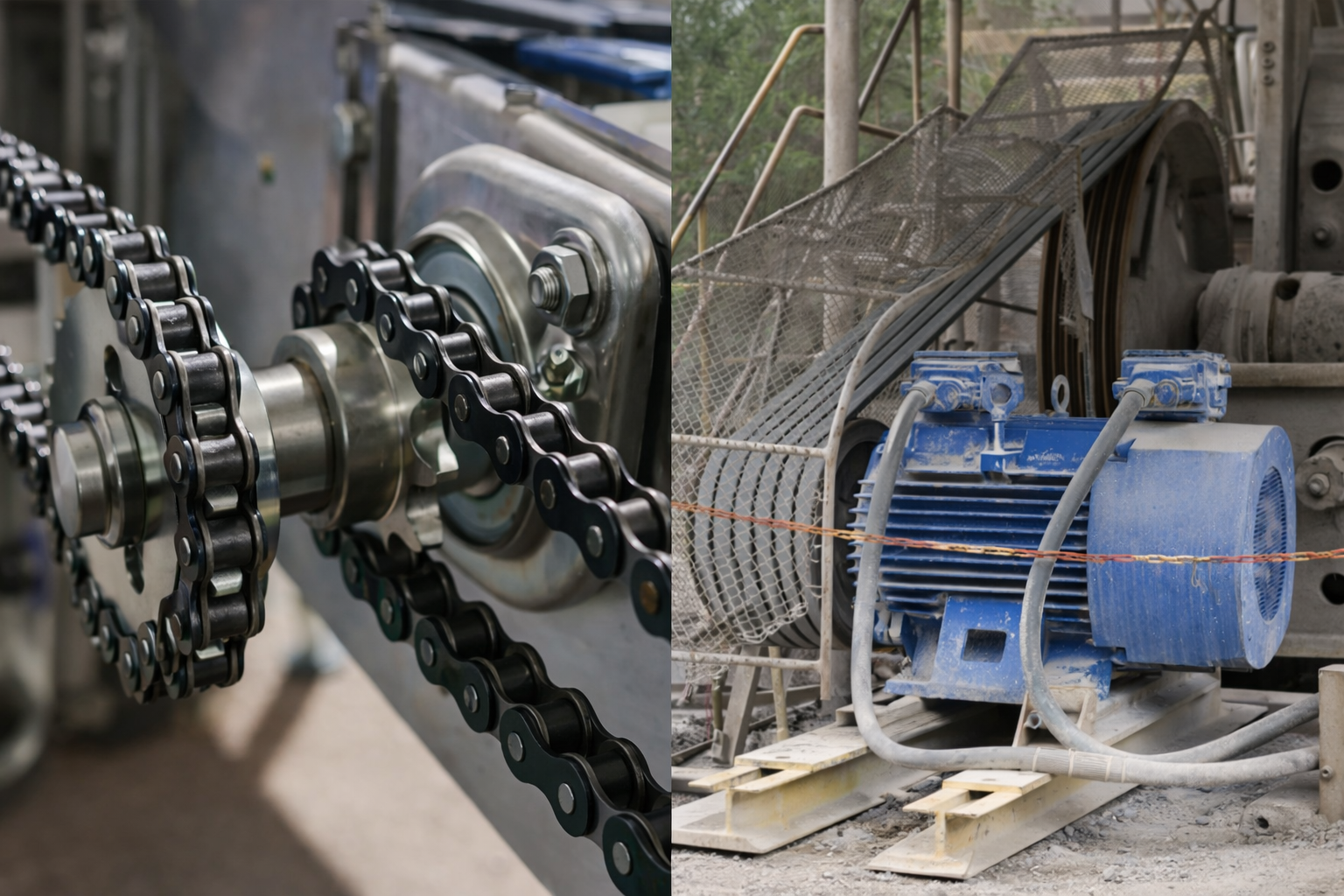
Belt Drives vs. Chain Drives: A Practical Overview
When machinery is down, choosing the right power transmission method isn’t about theory — it’s about what gets equipment running reliably again. Belt drives and chain drives are both proven options, each with strengths depending on the load, environment and maintenance setup.
This guide isn’t here to convince you one way or the other. It’s simply a clear overview of how the two systems differ, so you can pick the right solution for the job and keep things moving.
How Each System Transfers Power
Chain Drives: Positive Engagement
Chain drives use sprockets and interlocking metal links. Because the components physically engage, slip is virtually non-existent under normal use. That makes chains dependable in high‑torque, heavy‑load, or stop‑start applications where a positive drive is essential.
Chains don’t experience meaningful creep, though they can wear over time and require lubrication to stay consistent.
Belt Drives: Friction or Synchronous Contact
Belts rely on friction between the belt and pulley. They can slip if tension drops, loads spike or the belt begins to age. Tensioners and idlers help keep everything tight.
Modern synchronous (timing) belts take another approach: they have teeth that slot into pulley grooves, giving non‑slip performance similar to a chain but with quieter, smoother operation.
Cost, Maintenance and Day‑to‑Day Differences
· Installation and Upkeep
o Belts: Generally cheaper and quicker to install. They don’t need lubrication and maintenance is minimal, though belts will age faster and need replacement more frequently.
o Chains: More expensive upfront and require regular lubrication. Poor lubrication introduces friction, heat and noise — so maintenance is important.
· Noise and Vibration
o Belts: Quieter and more forgiving. Their flexibility helps absorb shock loads and vibration.
o Chains: Louder, especially when lubrication drops off or wear builds up.
· Operating Environment
o Belts: Not ideal in very hot, dusty or caustic environments. Heat and contaminants accelerate wear and increase the chance of slip.
o Chains: Handle harsh environments better, provided lubrication can be maintained.
Engineering Considerations
Torque calculations show the difference between the two systems:
Chain Drive Torque
T = (F₂ – F₁) × rₐ
F₂ = tight-side tension
F₁ = slack-side tension
rₐ = pulley/sprocket radius
Because chains don’t slip, calculations are more straightforward and system losses are easier to predict.
Belt Drive Torque
Belts require additional coefficients to account for slip and creep:
T = (F₂ – F₁) × rₐ × µ
T = (F₂ – F₁) × rₐ × (1 + C)
µ = friction coefficient
C = creep allowance
These formulas reflect what technicians see in the real world: belt performance depends heavily on condition, tension and installation.
Where These Systems Are Used
Both belt and chain drives show up across a wide range of industrial applications. The choice usually depends on load, distance and how much slip the system can tolerate.
Belt Systems
Belt drives are common in long‑distance conveying, where smooth, continuous movement matters more than high torque. Large overland conveyors often rely on belts supported by idlers and tensioning systems to manage stretch, reduce slip and maintain consistent operation over extended runs.
Belt systems are also widely used in general material‑handling equipment, where the priority is steady transport rather than heavy shock loads.
Chain Systems
Chain drives are typically used in equipment that demands positive, slip‑free engagement. High‑torque machinery — such as large cutting, dredging or heavy‑duty processing equipment — often uses chains to handle constant load and stop‑start power delivery.
In many facilities, conveyors running on inclines or under heavy load may switch from belts to chains to prevent slippage when gravity or torque increases.
Specialty Belt Applications
Advances in materials have led to more use of reinforced timing belts in compact, precise systems. These belts offer controlled, synchronous movement without the weight or noise of a chain — ideal for applications where accuracy is critical but loads aren’t extreme.
What’s Next for Belt and Chain Technology
Both systems continue to evolve.
Belts
· Improved v‑rib and cogged designs for better grip
· New materials aimed at increasing heat resistance and reducing stretch
· Lighter, stronger belts that keep tension more reliably
Chains
· Better alloys and friction‑reducing coatings
· Variable‑pitch designs for smoother running
· New lubrication technologies for harsher environments
Across both systems, condition monitoring is growing quickly. IoT sensors can now track lubrication flow, tension, vibration and temperature, giving workshops real‑time visibility into equipment health.
In Summary
There’s no universal “best” option. It comes down to the job:
· Choose belts for quieter operation, smoother running and lower upfront cost.
· Choose chains for high‑torque, heavy‑load or harsh‑environment work where slip can’t be tolerated.
What matters most is getting the machine running reliably and quickly — and understanding these differences helps you make the call with confidence.